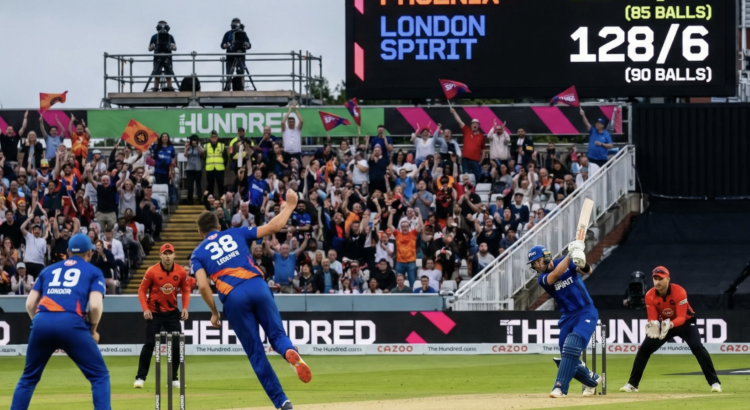
Launched in 2021 by the England and Wales Cricket Board, The Hundred is the newest and most distinctive cricket format in professional cricket. Each side faces exactly 100 balls — not 120 as in T20, not 300 as in ODI cricket — in a match that lasts two and a half hours from start to finish. The rules are deliberately streamlined: bowlers bowl in five or ten consecutive ball stints, the change of ends happens every ten balls, and the powerplay covers the first 25 balls of each innings. If T20 already felt fast, The Hundred compresses it further — and for bettors, that compression creates a specific set of market characteristics that reward understanding the format first.
Key Differences Between The Hundred And T20 Betting
The most important distinction between The Hundred and T20 betting is not the format itself — it is how the format affects market dynamics. Three structural differences stand out:
- Fewer balls = higher per-ball variance: In T20, 120 balls per innings means a single dismissal or boundary changes the run-rate by roughly 0.8%. In The Hundred, 100 balls means every delivery carries 20% more weight. A wicket in ball 10 of The Hundred is proportionally more damaging than a wicket in over 2 of a T20. This inflated per-ball significance compresses the window for markets to correct during live play.
- 25-ball powerplay vs 6-over powerplay: T20 powerplays last 36 balls (6 overs × 6 balls). The Hundred powerplay is 25 balls — almost one-third shorter. Teams that load their best batters to exploit the powerplay have a smaller window to do so, which means the post-powerplay phase (balls 26–100) is proportionally longer and the middle phase has greater influence on the final total.
- Bowling quotas per bowler: In T20, a bowler bowls a maximum of 4 overs (24 balls). In The Hundred, each bowler can deliver a maximum of 20 balls per match. This changes the bowling rotation strategy dramatically — and it creates specific situations where a bowler can be targeted for extended spells.
| Feature | T20 | The Hundred |
| Balls per innings | 120 | 100 |
| Powerplay | 36 balls (6 overs) | 25 balls |
| Change of ends | Every 6 balls | Every 10 balls |
| Max balls per bowler | 24 (4 overs) | 20 balls |
| Match duration | ~3 hours | ~2.5 hours |
| Tie-break | Super Over | Super Five |
Popular Betting Markets In The Hundred Matches
The match winner market in The Hundred operates similarly to T20 — two outcomes (or three including tied match at 2 points each), with odds reflecting team quality, home advantage, squad depth, and recent form. One specific Hundred dynamic: Oval Invincibles have been the dominant men’s franchise since the competition’s inception, winning back-to-back men’s titles in 2023 and 2024. Any market that includes them as favourites carries genuine historical support — they are the only men’s team to win consecutive titles.
Total runs markets in The Hundred typically follow this distribution based on four completed seasons (2021–2024):
| Score Range | Frequency |
| Under 100 | Rare (~5%) |
| 100–119 | ~15% |
| 120–139 | ~30% |
| 140–159 | ~30% |
| 160+ | ~20% |
The modal score range is 120–159 — wider than the equivalent T20 range because the shorter format means fewer recovery overs but similar batting depth. High-profile venues like Lord’s and Edgbaston produce more 150+ totals than smaller grounds.
Top Batter And Top Bowler Bets
The top batter market in The Hundred is structurally more open than in T20 because the shorter innings limits the probability of a single player dominating the complete innings. In 100 balls, a 60-ball 80 is already an outstanding individual score — the market odds reflect this with more spread across candidates.
Key top batter profiles to understand:
– Openers and top-order batters face the powerplay (first 25 balls) and benefit most from the fielding restrictions
– Middle-order batters at positions 3–5 often face the most complex phase of The Hundred — after the powerplay, against settled bowlers — making their selections higher-risk but better odds
– Finishers at positions 6–7 have limited balls but can accumulate quickly against fatigued attacks in the final 20 balls
Top bowler markets follow the wicket-taker pattern from T20, with one additional nuance: Fi Morris (Manchester Originals) recorded the best figures in The Hundred’s history with 5/7 in 2023. Kathryn Bryce (Manchester Originals)matched the five-wicket feat with 5/13 in 2024 — the only two five-wicket hauls in the competition’s history. These extreme bowling performances are rare but confirm that the market’s top bowler odds can be exploitable when conditions strongly favour a specific bowler type.
The Hundred Betting Strategies For New Bettors
Three foundational strategies apply specifically to The Hundred format:
Identify the bowling rotation pattern early: Because each bowler can only bowl 20 balls, captains must carefully manage their best bowler’s allocation. If a team’s primary strike bowler has already bowled 15 balls before the midpoint, the final 20 balls of the innings will be bowled by weaker options. Live total runs markets respond to this — when a top bowler exhausts their quota early, the remaining batting becomes structurally easier, and the Over in the total runs market strengthens.
Powerplay score as innings predictor: Research shows that the powerplay score (first 25 balls) is the strongest single predictor of the final total in The Hundred. A team scoring 35+ in the powerplay with no wickets lost is on course for a 140+ total in approximately 65% of cases. A team that loses 2 wickets in the powerplay and scores under 20 will finish below 120 in approximately 60% of cases. Using the live powerplay score to adjust your position on total runs markets — or top batter selections — is a disciplined and data-supported approach.
Home advantage in The Hundred: The Hundred’s eight venues are closely linked to their franchise identities. Edgbaston for Birmingham Phoenix, Lord’s for London Spirit, Headingley for Northern Superchargers (now Sunrisers Leeds). Home crowds, familiar surfaces, and pitch knowledge create measurable home advantages. Birmingham Phoenix and Oval Invincibles have historically performed above their away form at their home venues — a persistent pattern worth integrating into match winner betting.
Best Situations For Betting On The Hundred
The Hundred creates specific high-value betting windows that beginners should recognise:
Before the match (pre-match): The match winner market is most accurate when confirmed XIs are known. The Hundred teams often rotate overseas players — a squad with three available overseas slots will not always deploy all three. A side missing their best overseas batter due to international duty shifts the match winner probability significantly and may not be fully priced into pre-match odds until the XI is confirmed 30 minutes before play.
During the powerplay (balls 1–25 live): The live total runs market moves fastest during the powerplay. A strong or weak powerplay score immediately adjusts the market — but the adjustment takes 2–3 balls to fully settle. There is a brief window after a powerplay wicket where the market hasn’t yet fully compressed the Over probability, creating a potential value position on the Under.
The final 20 balls: The Hundred’s equivalent of the T20 death overs. Teams often use their most attacking batters at this stage, and the market’s live total estimate can lag behind the actual scoring pace. When a team with strong finishers (positions 6–8) comes to the crease in the final 20 balls, the live Over on the total is structurally supported.
Common Beginner Mistakes In The Hundred Betting
- Applying T20 analysis directly: The Hundred is classified as a T20 for statistical purposes, but its market dynamics are different. A 60-run total after the powerplay in T20 (36 balls) indicates strong form; 40 runs after 25 balls in The Hundred is comparably solid. Beginners who transpose T20 benchmarks without adjusting for the 100-ball format consistently misjudge live total markets.
- Ignoring the bowling quota: The 20-ball maximum per bowler is unique to The Hundred and has no parallel in T20 betting. Ignoring how much of a key bowler’s quota remains fundamentally skews total runs and top bowler analysis.
- Over-valuing franchise history in year-to-year markets: The Hundred squads change significantly each season through the draft and overseas player rotation. Oval Invincibles’ back-to-back titles (2023–2024) were achieved with specific squad compositions that may not persist. Beginners who back established franchises purely on historical success, without checking the current season’s squad depth and overseas availability, are betting on past performance rather than present probability.
- Underestimating women’s Hundred markets: The women’s Hundred runs simultaneously with the men’s competition, and the quality of betting markets is equivalent. London Spirit won the 2024 women’s title. The women’s markets often carry less sharp money than the men’s — which can mean genuine value is available for bettors who apply equivalent analysis to both competitions. The same structural frameworks (powerplay score, bowling quota, top batter profiles) apply equally to the women’s game.
Conclusion: Smart Approaches For The Hundred Betting
The Hundred is the most beginner-accessible cricket format for betting precisely because its rules are simple and its matches are short. One hundred balls, two and a half hours, a clear winner. The analytical challenge is not complexity — it is calibration. Adjusting T20 benchmarks for the 100-ball format, monitoring bowling quotas, and using the 25-ball powerplay as a live predictor are the three habits that separate disciplined Hundred bettors from recreational ones.
Start with match winner markets using confirmed XIs, apply the powerplay score as your primary live indicator, and keep unit sizes to 1–1.5% of session bankroll. The Hundred is designed for new audiences — and it rewards bettors who approach it with the same fresh eyes, unencumbered by assumptions carried over from longer formats.