Player performance markets are where cricket betting gets genuinely interesting. Unlike match-winner markets where the bookmaker’s edge is efficiently priced in, top batsman and top bowler bets reward research, cricket knowledge and situational awareness in ways that general match markets simply do not. A punter who understands pitch dynamics, batting positions and bowling conditions can find consistent edges here. This tutorial covers everything you need to approach these markets with confidence.
Understanding Top Player Betting Markets
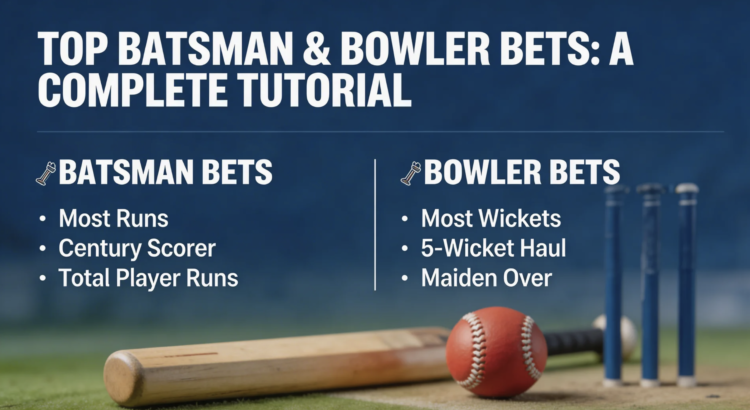
Top Batsman — You bet on which player will score the most runs in a match, an innings, or for a specific team. Markets are available for individual team top scorer (“Top RCB Batsman”) or across both teams (“Top Match Batsman”). The player who scores the highest runs wins the market.
Top Bowler — You bet on which bowler takes the most wickets in a match, innings, or for a specific team. Same structure as the batsman market — team-specific or match-wide.
Dead heat rule — This is critical to understand before placing any player market bet. If two players score the same number of runs or take the same number of wickets, most bookmakers apply a dead heat settlement: your winnings are divided by the number of tied players. Two-way tie = half your winnings. Three-way tie = one third. Always check the bookmaker’s dead heat policy before betting.
How Bookmakers Set Player Performance Odds
Odds compilers use three primary inputs when pricing player markets:
- Batting position / bowling role — Openers face the most balls in T20 and ODI cricket, so they are structurally favoured for top scorer markets. Spinners who bowl four full overs on a turning pitch are favoured in wicket markets.
- Recent form — Last 3–5 innings for batsmen, last 3–5 bowling performances for bowlers. This is the most heavily weighted short-term factor.
- Venue and conditions history — ESPNcricinfo data on a player’s average and strike rate at specific grounds is factored in. A batsman who averages 22 at a venue but 45 overall will be priced shorter than their general odds suggest.
Where the edge exists for bettors: Bookmakers process large volumes of data but are slower to adjust to very recent form shifts, injury returns, or tactical role changes. A spinner recalled to the XI for a subcontinental pitch after three matches out is sometimes priced on general season averages rather than the specific pitch context. That gap is where value lives.
Analyzing Batsmen Before Placing A Bet
Five questions to answer before backing any batsman:
- What is their batting position? In T20 cricket, openers face an average of 25–35 balls; a No. 6 batsman may face 8–15. The number of deliveries received is the single strongest predictor of run volume. In Tests, position matters less — a No. 4 can bat for two sessions if the situation demands.
- What is their recent form? Check ESPNcricinfo or Cricbuzz for last five innings. A player with scores of 62, 45, 71, 38, 55 is in a fundamentally different position than someone with 12, 4, 18, 0, 31. Odds do not always fully reflect this.
- How do they perform at the specific venue? Filter ESPNcricinfo stats by ground. Some batsmen thrive at high-altitude venues (thin air, faster outfield, shorter carry) while struggling at sea-level grounds with slow outfields.
- Who is bowling against them? Left-arm spin creates different problems than right-arm off-spin. Yashasvi Jaiswal against quality left-arm spin has shown vulnerability compared to his performance against pace. These matchup specifics are available in ESPNcricinfo’s advanced filters.
- Is there any tactical role ambiguity? A batsman who sometimes opens and sometimes bats at No. 4 depending on the match situation carries uncertainty that lowers their value in top scorer markets. Fixed batting positions are safer selections.
Key Metrics For Evaluating Bowlers
The equivalent checklist for bowler markets:
| Metric | Why It Matters |
| Full bowling allocation | Does the bowler bowl their full quota every match? A bowler capped at 2 overs has limited wicket-market exposure |
| Wickets per match (recent 5 matches) | Current wicket-taking form, more predictive than career averages |
| Economy rate on this pitch type | Spinners on dry surfaces vs. pace on green decks — surface alignment is critical |
| Batting lineup of opposition | Right-hand-heavy lineups vs. left-arm spinners creates more edges/chances for dismissal |
| Phase of match they bowl in | Death-over specialists (overs 17–20 in T20) face more aggressive batting; powerplay bowlers face more attacking shots |
In Test cricket, the new ball is the most wicket-productive phase. Bowlers who open the bowling on day one on a pitch with moisture have structurally higher wicket probability than those brought on first-change.
Match Conditions That Influence Player Outcomes
Pitch type is the most impactful single variable:
– Dry, dusty surface: Spin bowlers dominate. Ravindra Jadeja, Ravichandran Ashwin, and Kuldeep Yadav on Chennai’s Chepauk or Ahmedabad’s Narendra Modi Stadium are in structurally favourable bowling conditions. Bat-first totals tend to be lower.
– Green, seaming track: Pace bowlers take more wickets in the first two sessions. Jasprit Bumrah or Kagiso Rabada in Centurion or Headingley conditions carry higher wicket-market value.
– Flat, high-scoring surface: Hyderabad’s Rajiv Gandhi Stadium or Bengaluru’s Chinnaswamy — totals regularly exceed 200 in T20s. Top batsman markets become more attractive because more runs are scored overall, increasing the value of well-placed openers.
– Dew factor in day-night T20 matches significantly helps chasing teams, as fielding becomes harder and bowlers struggle to grip the ball after 8 PM. This reduces bowling effectiveness in the death overs and benefits the second-innings batsmen.
– Toss result — In T20s on flat pitches, the team batting second wins approximately 53–57% of matches due to dew and a known target. This affects the top run scorer market because the chasing team’s openers face the most balls in a match with clearer intent.
Format-Specific Strategies For Player Bets
T20 Cricket: Opening batsmen dominate top scorer markets due to maximum ball-facing time. Back players with confirmed No. 1 or No. 2 positions. Examples with confirmed IPL 2026 positions: Travis Head (SRH opener), Phil Salt (RCB opener), Ajinkya Rahane (KKR opener), Yashasvi Jaiswal (RR opener). In the bowler market, death-over specialists like Jasprit Bumrah (MI, retained at ₹18 cr) bowl under the highest pressure but take the most wickets when conditions suit.
ODI Cricket: The first 10 and last 10 overs are most productive for wickets. Swing bowlers with the new ball (overs 1–10) and death-over specialists (overs 41–50) are the two most productive betting profiles for top wicket-taker markets. For batsmen, opening partnerships are key — openers who survive the powerplay typically compile the highest scores.
Test Cricket: The dead heat risk is significantly higher in Test markets as multiple bowlers can finish with equal wickets across long matches. Consider smaller stakes or match-innings markets (top bowler in first innings only) to reduce this risk. In batting markets, No. 3 and No. 4 positions are most reliable — they combine security at the crease with time to build large innings.
Using Team Lineups And Tactical Roles
A confirmed XI always overrides any statistical projection. Until you have the playing XI, player market bets carry substantial structural uncertainty. Here is the verification process:
– IPL confirmed XIs are typically released 60–75 minutes before toss on official team social media accounts
– International match lineups are announced at the toss, but pitch-condition intelligence is available from curators’ pitch reports released the morning of the match
– Injury replacements announced within 24 hours of a match can completely invalidate a player performance bet
If a spinner you have backed for top bowler is replaced in the XI by a pace bowler due to unexpected pitch covering overnight, the bet is structurally compromised. This is why waiting for confirmed XIs before placing player markets is standard practice among experienced cricket bettors.
Common Mistakes In Top Player Betting
Backing star names at short odds: Virat Kohli at 2.50 in a top batsman market seems safe. But at those odds, he needs to top score in roughly 40% of matches to break even. Across a full IPL season, Kohli tops team scoring in approximately 30–35% of RCB innings. The math does not always work.
Ignoring batting position changes: A regular No. 3 promoted to opener for one match is a legitimate selection — maximum ball-facing time. But a regular opener dropped to No. 4 is now compromised. Match-day lineup checks prevent this error entirely.
Overweighting career averages vs. recent form: A batsman with a career average of 52 but scores of 0, 7, 12, 3, and 19 in their last five innings is statistically less likely to top score than their reputation suggests. Current form is more predictive than historical averages in the short term.
Neglecting dead heat probability in tight squads: When two players in the same team batting lineup are nearly equal in recent form and both open the batting (example: Salt and Kohli for RCB), the dead heat risk in the top team batsman market is elevated. Consider the match-wide top batsman market instead, which spreads the field further and reduces dead heat probability.
Live Opportunities In Player Performance Markets
In-play player markets move with every ball — and they move fastest after these triggers:
Wicket of a competitor — If Rohit Sharma is dismissed cheaply and you backed him for top MI scorer, live markets will adjust the remaining competitors’ odds immediately. If Ishan Kishan is the next most likely top scorer and his odds shorten from 3.50 to 2.20 in 30 seconds, that window of adjustment is where live value is captured or missed.
Powerplay score exceeding par — A batsman on 42* after six overs in T20 has already separated himself from the field. Pre-match top scorer odds of 4.50 may have compressed to 1.70. If you assess continued probability of topping the innings at above 60%, that compressed price still represents value.
Bowler taking two early wickets — A spinner who takes wickets in overs 7 and 9 of a T20 match typically sees their remaining allocation from overs 15–20. If the surface is turning, their live top wicket-taker odds will shorten but may still be above fair value if three wickets total is achievable.
Discipline rule: Never use live player markets to chase a pre-match bet that has gone wrong. If your pre-match top batsman selection was dismissed for 4, accept the loss. Placing a reactive live bet to “recover” introduces compounding loss risk that destroys bankroll faster than any analysis can rebuild it.
The top batsman and top bowler markets are among the most consistently analysable bets in cricket precisely because they are tied to individual performance variables that can be studied, measured and tracked over time. Build your pre-match checklist, confirm the XI before staking, watch for live triggers, and apply consistent unit sizing — and these markets become a genuine test of cricket knowledge rather than a gamble.