Of all the markets available in T20 cricket betting, the over/under total runs market is arguably the most analytically accessible for bettors at every level. Unlike match-winner markets dominated by team quality differentials, or player markets dependent on individual performance variance, total runs markets can be systematically approached using verified venue data, pitch reports and team composition — information that is publicly available before every match. Here is how to use it.
What Over Under Runs Betting Means In T20
How Total Runs Markets Work
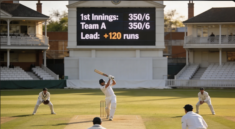
The bookmaker sets a run line — a projected total for either one team’s innings or the combined match total. You decide whether the actual total will go over or under that line.
Example: Bookmaker sets Match Total: 345.5 runs
– Bet Over 345.5 → You win if both teams combined score 346 or more
– Bet Under 345.5 → You win if the combined total is 345 or fewer
The 0.5 eliminates the possibility of a push (tie). Both sides are priced close to 1.90 decimal odds in most efficient markets — meaning the bookmaker’s implied probability is approximately 52.6% for each side, with the remaining 4.8% representing the bookmaker’s margin.
Team Totals Vs Match Totals Explained
You will encounter two variants of this market:
Match Total (both innings combined): Covers the full 40 overs of a T20 match. Higher variance because both batting lineups contribute. More influenced by pitch conditions affecting all bowlers equally.
Team Total (single innings): You bet on just one team’s innings total — “RCB Total Runs: Over/Under 178.5.” Lower variance, more focused. Better for when you have specific intelligence about one team’s batting lineup or the bowling attack they face.
Which to use: Team totals are preferred when one team’s lineup has a clear structural advantage or disadvantage that does not apply equally to both sides. Match totals are better when the pitch conditions affect both teams’ batting equally.
How Bookmakers Set T20 Run Lines
Odds compilers set run lines using:
– Venue historical average: The most heavily weighted factor
– Recent form of both batting lineups: Last 3–5 T20 matches
– Confirmed playing XIs: Squad depth, power hitters, specialist finishers
– Weather and toss conditions: Dew factor, wind, humidity
– Head-to-head at this specific venue
The run line is designed to attract roughly equal betting volume on both sides. When the market moves — i.e., the line shifts from 345.5 to 351.5 — it means the bookmaker is receiving significantly more money on one side and is adjusting the line to rebalance. Tracking line movement in the hour before a match gives you information about where informed money is flowing.
Pitch And Venue Analysis For Total Runs
This is the most data-rich area of T20 totals analysis. IPL venues have enough historical data to make reliable assessments, and that data is freely accessible on ESPNcricinfo and published in pre-match pitch reports.
Here are the confirmed IPL venue statistics you can use as benchmarks:
| Venue | Avg 1st Innings Score (IPL) | Bat 1st Win % | Pitch Character |
| M Chinnaswamy, Bengaluru | 185–195+ | ~44% | Flat, short boundaries, fast outfield — OVER-friendly |
| MA Chidambaram, Chennai | ~164 | ~57% | Slow, turning — UNDER-friendly |
| Wankhede, Mumbai | 175–185 | ~45% | Batting-friendly, dew-affected — OVER in 2nd innings |
| Rajiv Gandhi, Hyderabad | 180–200 | ~45% | Flat, high-scoring — OVER-friendly |
Key confirmed data points:
– Chinnaswamy (Bengaluru): Highest IPL team total 287/3 by SRH in 2024. Batting-second teams win 49 of 94 matches (52%). The flat pitch and short square boundaries consistently produce totals above 180 in even moderately contested matches.
– Chepauk (Chennai): Average first innings score of 164 across IPL history. In IPL 2025, across four matches, runs came at a scoring rate of just 8.1 per over — the lowest of all 12 venues used that season. Teams batting first win approximately 57% of matches here, unusual for T20 cricket, because spinners dominate and second-innings chases are disrupted by slow conditions.
– Wankhede (Mumbai): 66 of 121 IPL matches won by teams batting second. Dew significantly helps chasing teams, making second-innings batting easier after sunset. The venue is batting-friendly overall, though MI’s 61.8% home win rate shows how familiarity matters.
Practical application: When a match is at Chinnaswamy, the structural default is to consider the Over. When a match is at Chepauk with a spinner-heavy attack in play, the structural default is the Under. You are not betting blindly — you are applying verified historical base rates.
Team Batting Strength And Lineup Depth
Beyond venue data, the confirmed batting lineup is your most actionable variable. Three things to check:
Power hitters in the XI — Teams with multiple destructive batsmen (100+ strike rate consistently) produce higher totals. SRH’s 2024 season, when they averaged 228+ in the first innings, was driven by Travis Head, Abhishek Sharma and Heinrich Klaasen at the top. All three are confirmed in SRH’s IPL 2026 squad. Matches involving SRH in batting-friendly venues carry structurally higher over-probability.
Batting depth — A team batting 8 deep (all-rounders at 6, 7, 8 who can genuinely score) produces more runs in the final five overs than a team with a long tail. KKR’s acquisition of Cameron Green (₹25.20 crore) adds genuine batting depth to their middle order alongside Rinku Singh — relevant for totals markets in their home matches at Eden Gardens.
Impact player availability — In IPL 2026, the Impact Player rule (where teams can substitute one player during the innings) allows a team to effectively use 12 players per match. An all-batting impact player substituted in at the 7th wicket instead of a specialist bowler boosts expected run totals. Always check impact player usage patterns of each franchise.
Bowling Units And Their Influence On Totals
A batting-friendly pitch means nothing if the bowling attack is historically restrictive. Balance your venue assessment with the bowling quality on show.
Economy rate by bowling type on different surfaces:
In Chepauk IPL 2025 data: Spin economy: 7.2 runs per over vs Pace economy: 9.0 runs per over. This tells you that on a turning Chennai surface, a spin-heavy attack (CSK with Noor Ahmad, Jadeja, Ashwin) dramatically suppresses totals compared to a pace-heavy lineup.
Key questions before betting totals:
– Is the bowling attack pace-heavy or spin-heavy?
– Does that suit the pitch type?
– Does the bowling attack have a genuine death bowler who can restrict runs in overs 16–20?
– In IPL 2026, Jasprit Bumrah (MI), Matheesha Pathirana (KKR, ₹18 crore) and Arshdeep Singh (PBKS) are the most reliable death-over restrictors. Matches featuring these bowlers in familiar home conditions skew slightly toward the Under in death-over-specific markets.
Live Over Under Betting During The Match
The powerplay (overs 1–6) is the single most valuable data point for live totals betting. It sets the trajectory of the innings.
Powerplay benchmarks for live betting context:
– 55+ runs with 2 wickets or fewer: Batting team on course for 185–200+. Consider live Over for team total.
– 40–50 runs with 3+ wickets: Likely mid-170s total. The market will have already adjusted — look for value only if you believe the middle overs can accelerate.
– Under 35 runs with 2+ wickets: Structural Under signal. The innings is under pressure and the team will likely fall short of the pre-match line.
Wicket impact on live run lines: A key wicket (opening batsman dismissed in over 8–10) typically reduces expected total by 12–18 runs in bookmaker live models. This adjustment happens within seconds of the wicket. If you believe the next batsman is well-suited to the conditions and can absorb that drop, the adjusted live Over may carry value.
Common Mistakes In T20 Total Runs Betting
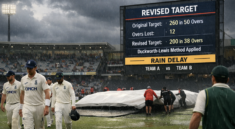
Ignoring weather: Rain interruptions that reduce overs recalculate the market via Duckworth-Lewis-Stern (DLS). A match reduced to 16 overs per side has a completely different run line than the original 20-over contest. Bookmakers adjust, but sometimes slowly — verify the run line reflects the current over count.
Betting totals without confirmed XIs: A key power hitter’s injury, announced 45 minutes before toss, can shift the expected team total by 15–20 runs. Placing over/under bets before confirmed lineups introduces unnecessary variance.
Treating all over/under lines as equal: A match line of 345.5 on a Chepauk pitch is structurally different to 345.5 at Chinnaswamy. Context is everything. The same numeric line represents very different implied probabilities depending on the venue.
Betting against confirmed pitch conditions: If the Chepauk curator has prepared a dry, turning surface and the pitch report confirms grip for spinners, betting the Over requires significantly stronger counter-evidence than just “both teams are batting well in recent matches.”
Using Statistics To Find Value Opportunities
The most reliable statistical source for IPL venue data is ESPNcricinfo’s ground stats filter, which allows you to break down average innings totals by venue, season, batting first/second, and conditions. Cricbuzz publishes pre-match pitch reports from curators that are often more accurate predictors of scoring conditions than general venue averages.
Two data points to always check:
– Venue average first innings score vs the bookmaker’s run line for team totals
– Chasing team win rate at the venue as an indicator of second-innings conditions
If the bookmaker’s line is set significantly above the venue’s average first innings score (say, 185.5 at a ground averaging 168), that is a structural signal worth investigating before backing the Over automatically.
Building A Consistent T20 Totals Strategy
A reliable totals strategy for IPL 2026 follows this three-step process before every bet:
- Venue baseline: Pull the historical average first innings score for the specific ground from ESPNcricinfo. This is your anchor.
- Conditions adjustment: Factor in pitch report (flat/turning/seaming), toss result, day or night match (dew factor for evening games), and weather. Adjust your expected total up or down from the baseline.
- Lineup comparison: Check confirmed XIs. Does either team have a significantly stronger or weaker batting lineup than their season average? Are death-over specialists present? Is the Impact Player likely to be a batting or bowling option?
Only when all three steps point in the same direction — venue, conditions, and lineup all suggesting Over or all suggesting Under — does the confidence level justify a standard unit bet. When the signals are mixed, the market is likely efficiently priced and the edge is minimal. In those cases, passing on the market is a legitimate and profitable decision over a long season. The matches where all three factors align clearly are the ones worth betting.