Rain is cricket’s most unpredictable variable. And in betting, unpredictability is where money is made — or lost. The Duckworth-Lewis-Stern (DLS) method governs how rain-affected limited-overs matches are resolved, and every punter who bets on cricket without understanding it is operating with a serious blind spot. Weather interruptions can instantly invalidate a pre-match bet or create a live opportunity that the majority of the market misses.
What The Duckworth-Lewis-Stern Method Means In Modern Cricket
The Duckworth-Lewis-Stern method (DLS) is a mathematical formulation designed to calculate the target score for the team batting second in a limited-overs cricket match interrupted by weather or other circumstances. It was devised by English statisticians Frank Duckworth and Tony Lewis, introduced in 1997, and officially adopted by the ICC in 1999. After the retirement of both Duckworth and Lewis, Australian statistician Steven Stern became the custodian of the method, which was renamed to its current title in November 2014.
The DLS method works on the principle that a batting team has two resources when starting an ODI innings: overs available and ten wickets. As the innings progresses, these resources deplete, eventually reaching zero when a team either plays all deliveries or loses all 10 wickets.
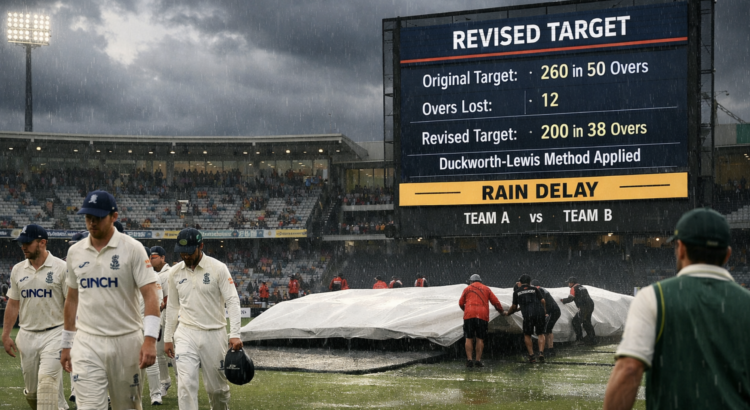
In simple terms: if rain costs a chasing team 10 overs, DLS does not simply divide the runs proportionally. It considers overs left and wickets in hand — the idea being that a team with more overs and wickets has more resources to score runs. DLS tries to give a fair target based on the resources lost due to rain.
As of November 2025, the DLS method serves as the mandatory standard for target recalculations in all ICC events, including ODIs, T20Is, and domestic competitions under ICC affiliates.
When The DLS Rule Is Most Likely To Affect A Match
Not every rain delay triggers DLS. The method only applies when overs are actually lost — a brief shower during which play resumes within the scheduled break does not require recalculation. The high-risk scenarios for DLS intervention are:
– Monsoon season cricket in India (June–September) — heavy afternoon rain is routine at venues like Kolkata, Mumbai and Chennai during this period
– Day-night ODIs where early evening thunderstorms are forecast
– Tournaments with tight scheduling — ICC events, IPL playoffs — where reserve days may not exist for group stage matches
– Toss-time weather uncertainty — if the sky is overcast at toss and a morning forecast shows rain arriving between overs 30–40, the second innings is structurally at DLS risk
Key minimum over requirements:
– ODIs: Each team must face at least 20 overs for a result to be declared using DLS
– T20Is / T20 franchise cricket: Each team must face at least 5 overs; the team batting second must face at least 5 overs for a DLS result
If these minimums are not met, the match is declared a No Result — which is critical for bettors.
How Revised Targets Influence Betting Odds
The moment rain interruption appears likely, live odds move — sometimes before a single drop has fallen. Bookmakers run their own DLS calculations in real time and adjust match-winner odds based on the projected revised target.
Here is what typically happens:
Team batting first, ahead of DLS par score when rain arrives → Their match-winner odds shorten immediately. They are on track to set a target above what DLS would impose on the chasing team.
Team batting second, behind DLS par score when rain arrives → Their match-winner odds lengthen rapidly. If the match ends without further play, they lose on DLS par, not on the actual score.
Par score is the total a chasing team should have reached — when they are ‘X’ wickets down — at the time of an interruption; target is the revised score required after an interruption. The par score changes according to the number of wickets lost.
This distinction between par and target is fundamental for live betting. A chasing team can be ahead of actual required rate yet behind DLS par if they have lost too many wickets. Bookmakers price this correctly within seconds of each ball. The bettor watching the match can see the fielding positions, the bowlers remaining, the pitch conditions — contextual data the algorithm cannot fully price.
Impact On Match Winner And Total Runs Markets
Match Winner market: DLS intervention fundamentally reassigns probability. A team that appeared to be cruising at 120/2 after 20 overs in a T20 chase can suddenly be facing a revised target of 142 from 16 overs — a much tighter proposition. Conversely, a team that was struggling at 80/4 in 15 overs may benefit from a rain reduction that wipes out their most dangerous remaining overs.
Total Runs market: This market is particularly vulnerable to DLS. Most bookmakers settle total runs bets based on actual runs scored, not adjusted or DLS targets. If a match is reduced mid-first-innings, pre-match Over/Under bets on match total may be voided entirely, depending on the bookmaker’s individual rules. Always check your bookmaker’s rain/no result policy before placing total runs bets on weather-affected fixtures. Some operators void all pre-match totals bets if fewer than the stated minimum overs are completed; others settle at reduced-over par values.
Team Advantage Under The DLS System
It is argued that DLS may inadvertently favour teams with robust middle and lower-order batting. Essentially, teams strong in their later overs can capitalise in a shortened match.
This is a documented structural bias with practical betting implications. Teams like India and England, with batting lineups that go 8 or 9 deep with genuine run-scorers, hold a structural edge in shortened-format DLS scenarios because their resource depletion is slower — they lose fewer resources per wicket than teams with long tails.
A team which is already six down after 20 overs will have less to lose from a 10-over interruption than a team which is only two down at that stage, because in the first case the team has already lost a huge chunk of their batting resources through dismissals. This is the most counter-intuitive aspect of DLS for casual bettors: a team struggling and wicket-heavy can sometimes benefit from a rain reduction.
Practical betting implication: In a rain-threatened match where one team has superior middle and lower order depth, their DLS-scenario odds carry more value than their general form suggests.
Format-Specific Effects Of The DLS Method
T20 Cricket: DLS is most volatile in T20s. Concerns have been raised as to its suitability for Twenty20 matches, where a high-scoring over can drastically alter the situation of the game. A 6-ball over producing 24 runs can swing the DLS par score significantly in a compressed 20-over game. Pre-match totals bets are particularly exposed in T20s when weather is forecast.
ODI Cricket: DLS works most reliably in the 50-over format, which is what it was originally calibrated for. The longer format provides more data points for the algorithm, reducing extreme swings. However, mid-innings interruptions when a team is 6 wickets down still produce counter-intuitive results as outlined above.
Test Cricket: DLS does not apply to Test cricket. Rain simply costs overs and potentially forces draws. This has no equivalent betting impact to limited-overs matches. However, the draw market in Tests is directly affected by rain — a Test heading toward a decisive result can shift to a near-certain draw following a full day’s rain loss.
Historical Matches Where DLS Changed Outcomes
1992 World Cup semi-final — England vs South Africa: The match that made DLS necessary. South Africa needed 22 runs from 13 balls when rain stopped play for 12 minutes. When play resumed, the revised target under the then-current Most Productive Overs system left South Africa needing 21 runs from one ball — a virtually impossible target. DLS was developed directly as a response to this outcome.
2009 West Indies vs England ODI: The West Indies coach John Dyson called his players in for bad light believing his team would win by one run under the D/L method, not realising that the loss of a wicket with the last ball had altered the Duckworth-Lewis score. In fact match referee Javagal Srinath confirmed that the West Indies were two runs short of their target, giving victory to England. A vivid example of how a wicket at the moment of interruption can reverse a DLS result entirely.
IPL 2023 Final — CSK vs Gujarat Titans: Rain disrupted the final when Chennai Super Kings had scored 4/0 after 0.3 overs and Gujarat Titans had just scored 214/4 from their 20 overs. The target was reduced to 171 runs from 15 overs. Chennai Super Kings won by 5 wickets by the DLS method, reaching 171/5 from 15 overs. Pre-match total runs bets on the final would have been severely impacted by the innings reduction.
India vs Australia ODI, October 2025: Rain reduced India’s target to 131, prompting commentator Aakash Chopra to call it an “injustice” due to the method’s failure to account for match context adequately. Another recent case where the DLS calculation drew widespread criticism.
Practical DLS Checklist For Bettors
Before placing any bet on a rain-threatened match, run through this checklist:
| Check | Action |
| Weather forecast | Check Accuweather or IMD for hourly rain probability at the specific venue city |
| Bookmaker void policy | Read the operator’s T&Cs for rain/no result settlement on total runs and match-winner markets |
| Minimum over rule | Confirm that enough overs are scheduled for a result to be declared |
| Team batting depth | Assess which team benefits more in a DLS shortened scenario |
| Toss result | Batting first in uncertain weather gives DLS-position control |
| Live par score tracking | Monitor the live DLS par score during in-play betting — available on ESPNcricinfo’s live scorecard |
DLS is not the enemy of cricket betting — it is a tool that creates information asymmetry between bettors who understand it and those who do not. The punter who knows what a DLS par score means, who benefits from wicket-heavy interruptions, and which bookmaker voiding policies apply to rain-affected totals is operating with a genuine structural edge over the majority of the market. That edge is built entirely on public, verifiable information. Understanding it is the work — and the reward.