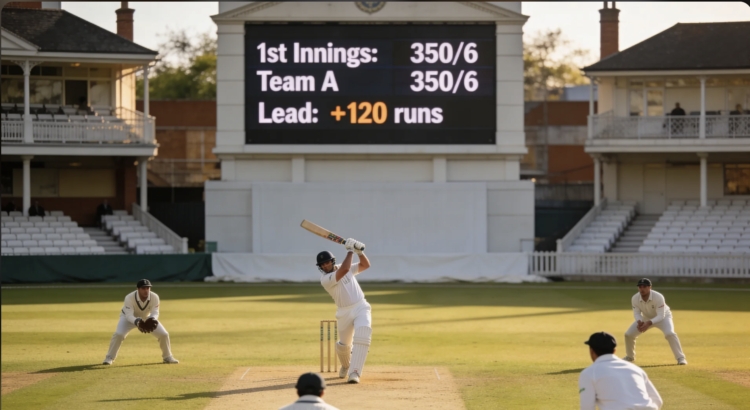
Test cricket is the format where betting patience and analytical depth pay the richest dividends. While T20 and ODI markets move quickly and compress decision windows, Test match markets — particularly the first innings lead — offer hours of information gathering before the moment of maximum value. The first innings lead market is one of the most underappreciated markets in all of cricket betting, and the historical data that supports it is some of the most compelling in the sport.
Why First Innings Lead Markets Matter In Test Cricket
The first innings lead is not just a statistical curiosity — it is the single strongest predictor of the eventual Test match result. The data from 2,085 Test matches across 135 years of Test cricket is unambiguous: when a team scores 300+ in their first innings, they win or draw the match in 63.5% of cases. When that first innings score rises to 400+, the win-or-draw percentage climbs to 70.3%. The team that establishes a first innings lead has structural control of the match — they set the length of the game, they bowl last on the worn pitch, and they dictate the psychological pressure on the opposition across days 3, 4 and 5.
For bettors, this translates directly into market value. A team trailing by 120 runs on first innings has their match-winner odds lengthened significantly — often correctly. But the first innings lead market itself settles before the match is over, offering a separate, earlier betting opportunity with its own set of analytical inputs.
Understanding The First Innings Lead Market
The first innings lead market is straightforward: which team will score more runs in their first innings? It settles when both teams have completed their first innings — either all out or declared. In a match where Team A scores 380 and Team B scores 310, Team A wins the first innings lead market regardless of how the match eventually ends.
Key settlement rules confirmed across major bookmakers:
– The market settles on the official first innings scores only — second innings runs are irrelevant
– Abandoned matches or matches with no result void the market
– Declarations count as the completed first innings score
Why this market has structural value: It settles early (typically end of day 2 or day 3), removes the draw variable entirely, and can be analysed with more precision than the full match-winner market because fewer variables (pitch wear, weather over 5 days, injury accumulation) affect it.
Pitch Behavior And Its Impact On First Innings Scores
The pitch on day 1 of a Test match is fundamentally different from the pitch on day 4. Understanding this difference is the foundation of first innings lead analysis.
Three pitch profiles and their first innings implications:
Seaming/Swing conditions (England, New Zealand, South Africa): Day 1 moisture and overhead cloud cover assist swing and seam movement, typically leading to collapsed early innings. The average first innings score in England has historically been lower than in Australia or the subcontinent. At Edgbaston specifically — one of the most analysed Test venues — teams batting first have won only 13 out of 40 Tests when choosing to bat, losing 16 of those 40. The conventional wisdom of “bat first” does not hold at swing-friendly venues.
Flat subcontinent surfaces (India, Pakistan, Sri Lanka): The dry surface favours second-innings batting on day 1 and 2 in Indian conditions. ESPNcricinfo data confirms that eight of the last nine Tests in India have been won by the side batting second — a dramatic statistical shift from the historical “bat first” assumption. This is because early moisture on Indian pitches allows swing/spin early, the pitch flattens in the middle overs, and by day 3 the ball starts reversing — affecting the first innings team.
Bouncy Australian surfaces: Australia’s pitches with true bounce produce the highest result percentage of any country — approximately 75% of Tests produce a decisive result. The average current-era first innings score is around 340–350. First innings leads are most predictive in Australia because pitches deteriorate predictably and the fourth innings chase is historically the most difficult here.
Toss Influence And Match Situation Analysis
Tests have the highest percentage of teams batting first after winning the toss — significantly higher than in limited-overs formats. Yet the outcomes tell a nuanced story. Since the beginning of 2000, teams batting first have won 217 Tests but lost 250 — meaning the traditional “win toss, bat first, control the match” assumption has been statistically invalidated in the modern era.
Toss analysis for first innings lead betting:
The toss decision reveals the captain’s assessment of the surface. When a captain wins the toss and chooses to bowl first— against the conventional instinct — they are signalling one of two things: significant day 1 assistance for their bowlers, or a belief that batting will be easier on a rested day 2 pitch. Both scenarios affect first innings lead probability significantly.
| Toss decision | Market implication |
| Bat first (conventional) | Captain confident in their batting lineup vs current conditions |
| Bowl first (against convention) | Captain expects early wickets; batting team faces disadvantage if conditions assist |
| Bowl first (conventional on fast tracks) | Australian-type surfaces — consistent with expected strategy, no edge signal |
The insight: when a captain bats first despite the pitch clearly favouring bowling (green, damp), the bookmaker’s first innings lead odds may not fully reflect the structural disadvantage they have taken on. The bowl-first decision on a bouncy, overcast day 1 is actually the higher-percentage play — and the odds on the bowling team to win first innings lead may carry value.
Team Strength In Long-Format Batting
First innings lead markets reward teams with deep batting lineups more than any other factor beyond pitch conditions. A team batting 8 deep — where numbers 7, 8, 9 are capable of 30–50 run contributions — consistently adds 50–80 runs to first innings totals compared to teams with exposed tails.
Currently the deepest Test batting lineups (by confirmed squad composition, 2025-26):
– England under Ben Stokes: the “Bazball” approach means aggressive batting at every position. Joe Root (6th in all-time Test runs with 12,972 runs), Ollie Pope, Ben Duckett all average above 45 in current form. Importantly, England’s batting philosophy under Stokes means they routinely bat first and post large totals regardless of conditions.
–India: Rohit Sharma (retired from Tests), but Yashasvi Jaiswal, Shubman Gill and KL Rahul provide a top three of genuine quality. The challenge is the tail — India’s batting average drops sharply from No. 7 onwards.
– Australia: The most consistent first-innings performers over the past decade. Steve Smith’s Test batting average of 56.92 (one of the highest in history for an active batsman) anchors their first innings regularly.
Venue And Historical First Innings Trends
Specific venue data is the most reliable pre-match input for first innings lead betting. The patterns are consistent and publicly available:
| Venue | Avg 1st innings score | First innings advantage |
| Lord’s, London | ~280–310 | Moderate — swing Day 1 |
| Edgbaston, Birmingham | ~334 | Low for batting first team — chasing side wins often |
| MCG, Melbourne | ~350+ | High — flat track, large ground |
| Chepauk, Chennai | ~260–290 | Spin by Day 3 — second innings batting can be easier |
| Wanderers, Johannesburg | ~320–340 | High bounce — pace battery teams favoured |
| Lord’s vs Australia (Ashes) | ~275–300 | Swing for England historically |
The average first innings score in the current era is around 340–350 — a 7% increase from the previous era. This means bookmakers using older models may systematically underprice first innings Over lines in matches at batting-friendly venues.
Timing Your Bets For Maximum Value
The best value windows in first innings lead markets:
Pre-toss: The market is set on general team strength and venue history. Value exists when the bookmaker has not fully accounted for pitch report intelligence. Morning-of-match pitch reports from curators (available on ESPNcricinfo and official venue channels) often reveal surface conditions that shift first innings lead probability before the bookmaker adjusts.
Post-toss, pre-first-ball: The toss decision is now known. When a captain makes a counter-intuitive decision (bats first on a green surface), the odds on the opposition winning the first innings lead may not immediately reflect this correctly. There is a 15–30 minute window before the bookmaker fully adjusts.
After 10 overs of play: By over 10, you know whether the pitch is assisting bowlers or batsmen. If a team is 2 down for 40 on a surface that looked flat, the first innings lead odds have shifted — but if the remaining batsmen are top-order quality (Root, Smith, Kohli) and the pitch is settling, the live Under for the bowling team may still carry value.
Smart Strategy For Consistent Test Match Profits
The pre-match first innings lead checklist:
- Read the pitch report. Not the general venue data — the specific match-day pitch report from the curator. Green tinge, cracked surface, damp areas: each signals different Day 1 behavior.
- Note the toss decision and assess its logic. Counter-intuitive toss choices are the most information-rich signal available. They suggest the captain has more certainty about conditions than the market.
- Compare batting depth of both lineups. Which team bats to No. 8 with confidence? That team wins first innings lead markets at a higher rate than their match-winner odds imply, because the first innings is precisely the phase where depth manifests.
- Check weather forecast across Day 1 and Day 2. A sunny Day 1 followed by overcast Day 2 means the team batting first may get better conditions — the reverse hurts them. Weather affects the first innings more than any other innings because both teams are playing their first innings in the same match conditions period.
- Apply standard unit sizing. First innings lead markets are slower-settling and lower-variance than match-winner markets in T20. A standard 1.5–2% unit is appropriate. The longer settlement window (end of Day 2–3) also allows for live assessment before full commitment.
Teams batting first with first innings scores of 300 or above win or draw 63.5% of matches; that percentage rises to 70.3% when the first innings score reaches 400+. These are not projections — they are 135 years of verified Test cricket data. The first innings lead market is a direct bet on establishing that structural control. The punter who combines pitch intelligence, toss analysis, and batting depth assessment is operating with the same information that experienced Test captains use to make their most important decision of the match.