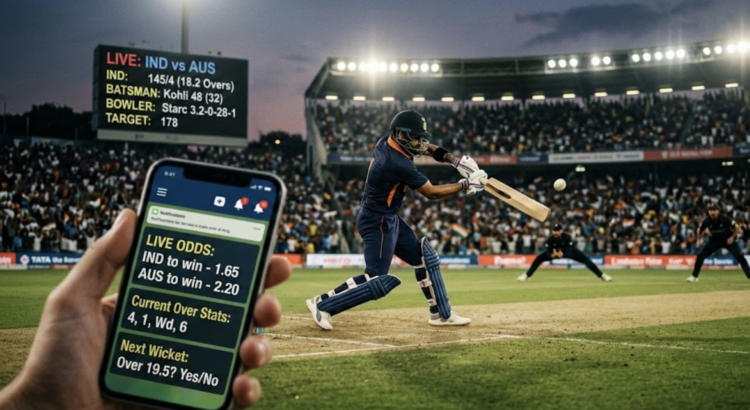
Pre-match betting is calculated and deliberate. Live cricket betting is fast, reactive, and infinitely more complex. The same match that appeared straightforward before the toss can become a completely different proposition within three overs — a collapsed top order, an unexpected pitch assistant to the spinner, an injury to a key bowler in the fourth over. In-play markets absorb all of this in real time, and the bettors who understand how odds move and why are the ones who find consistent value here.
What Makes In-Play Cricket Betting Different
In pre-match betting, odds are set using squad data, venue history and form. In live betting, those odds are recalculated after every single delivery — by algorithms processing run rate, wickets remaining, required rate, fielding conditions, dew factor and historical data from thousands of similar match situations.
The speed of change is significant. A match-winner odds on a team batting first can swing from 1.60 to 3.20 in under 60 seconds following two quick wickets in the powerplay. This is not guesswork — it is machine-driven probability recalculation. The opportunity for bettors exists precisely because algorithms sometimes overcorrect, and a sharp observer watching the match can identify when the odds have moved further than the genuine probability shift warrants.
Key Advantages Of Live Markets
Three structural advantages of in-play over pre-match betting:
Information advantage: You can see the actual pitch behavior in the first two overs before placing any bet. Bookmakers set pre-match odds on curator reports; you can verify those reports with your own eyes at the start of the match — before committing any stake.
Tactical revelation: Captains reveal their plans in real time. When a T20 skipper holds Jasprit Bumrah back until over 15, or brings on the spinner in the powerplay, those tactical decisions shift the probability landscape in ways the pre-match model did not fully price.
Momentum markets: Live-only markets such as next wicket method, next over total, fall of next wicket, session runs and ball-by-ball prop bets are only available in-play. These micro-markets reward specific cricket knowledge that is difficult to model algorithmically.
Understanding Momentum In Cricket Matches
Momentum in cricket is measurable, not just felt. Three validated momentum indicators that directly influence live odds:
Wicket clusters — Two wickets in the same over or in consecutive overs represent a fundamental shift in match balance. The incoming batsman faces psychological pressure, the bowling side is energised, and the fielding positions change. Historically, teams losing their 3rd wicket before over 10 in a T20 chase win approximately 35% of matches compared to a baseline of 53% for chasing teams generally.
Scoring rate acceleration vs. required rate — When a chasing team’s required rate climbs above 12 runs per over in overs 10–15 of a T20 chase, their win probability drops sharply. When a team is consistently scoring above required rate for three consecutive overs, the pressure is reversed and odds shift accordingly.
Bowling change response — When a part-time bowler is introduced and immediately struck for consecutive boundaries, the batting team’s momentum is visibly building. Live match-winner odds often lag behind this shift for 2–3 balls — that window is where observant bettors find value.
Reading Run Rate And Required Rate Trends
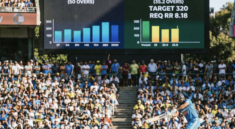
Required run rate (RRR) is the single most important number in live T20 and ODI betting. It is the run rate needed to win from any point in an innings and is calculated as: Runs needed ÷ Overs remaining.
Critical RRR thresholds in T20 chases:
| Required Rate | Match situation | Win probability (general) |
| Below 8.0 | Chasing team comfortable | 65–75% |
| 8.0 – 10.0 | Competitive, balanced | 45–55% |
| 10.0 – 12.0 | Chasing team under pressure | 30–40% |
| Above 12.0 | Batting team struggling | 15–25% |
| Above 15.0 | Near-impossible | Under 10% |
These are general ranges, not guarantees — a T20 pitch with flat conditions and a short boundary can make a 13-an-over target more achievable than the probability suggests. This is exactly the type of contextual analysis that beats algorithmic live odds.
Live Conditions That Influence Outcomes
Three live conditions that consistently move odds in predictable directions:
Dew factor in evening T20s — As temperature drops post-sunset in Indian conditions, dew makes the ball difficult to grip. Seam and swing bowlers lose effectiveness. This is a structural advantage for the batting team in overs 15–20 of a second innings. If a chasing team needs 60 runs off the final 5 overs on a dewy evening, the required run rate is more achievable than it appears numerically — and live odds often reflect the dew factor slower than actual conditions warrant.
Fielding restrictions — The first six overs of a T20 innings are played with only two fielders outside the 30-yard circle. This powerplay period is the highest-scoring phase on average. When three wickets fall in the powerplay, the batting team’s approach for overs 7–15 changes dramatically — from aggressive to consolidating — which suppresses the total. Live totals markets immediately after a third powerplay wicket represent a predictable betting environment.
Light and visibility — In late-afternoon ODIs or day-night Tests, changing light conditions significantly affect batting comfort and bowler effectiveness. These are real-time factors that algorithms process slower than a match-viewer.
Using Team Strategy And Player Roles
In-play strategy intelligence goes beyond the scorecard. Three tactical elements to track:
Bowling rotation patterns — When an opposition captain exhausts their best bowler’s overs early (Bumrah or Rashid Khan used up before over 16), the death overs become structurally weaker. Live over-total markets for overs 17–20 carry Over value when the premium bowling is already spent.
Batting aggression signals — A batsman’s running between the wickets, backing away to slower bowlers, or reverse-sweeping against conventional spin are visual indicators of intent that precede scoring acceleration. These signals appear before the algorithm can process them from ball-by-ball data.
Impact Player tactical shift — In IPL 2026, teams use the Impact Player substitution at strategic moments. When a team substitutes in an additional batting specialist at the 7th wicket fall, total runs available in the last 3 overs increase — a live Over signal for remaining innings run markets.
Common Mistakes In Live Cricket Betting
Chasing pre-match losses live — This is the most frequent and most destructive error in in-play betting. A pre-match bet that has gone against you is already settled by the match situation. Placing reactive live bets to “recover” that stake introduces compounding risk. Every live bet must be evaluated on its own merits, completely independent of prior results.
Betting on every over — Live cricket generates the feeling that every moment is a betting opportunity. It is not. Disciplined in-play bettors identify 2–3 high-conviction moments per match and stake accordingly, rather than placing small bets continuously which compounds the bookmaker’s margin across the session.
Ignoring the odds compression timeline — After a major wicket, odds shift within 3–5 seconds. By the time most bettors have processed the dismissal and navigated to the market, the adjusted price is already live. Reacting to moments you have already seen — rather than anticipating the next shift — is consistently too slow for in-play value capture.
Betting against the pitch — A live spinner taking wickets on a turning Chepauk surface is doing exactly what the conditions dictate. Betting that the batting team will recover and outscore the market after three spin wickets requires strong counter-evidence, not just optimism.
Managing Bankroll During Live Sessions
Live betting creates a psychological acceleration that pre-match betting does not. The speed of markets and the emotional involvement of watching a match live produce impulse decisions that destroy bankroll faster than any analytical mistake.
Three non-negotiable rules for live sessions:
- Set a session maximum before the match starts. Decide the maximum you will stake across the entire live session — not per bet, but total. When you hit that limit, stop.
- Never increase unit size mid-session. If your standard live unit is ₹200, it remains ₹200 for the entire session regardless of early wins or losses.
- Log every live bet in real time. Date, market, odds, stake, reasoning. Without a log, emotional recollection distorts your assessment of what actually happened.
| Session Bankroll | Recommended session max | Live unit size |
| ₹2,000 | ₹400 | ₹50 |
| ₹5,000 | ₹750 | ₹100 |
| ₹10,000 | ₹1,500 | ₹200 |
| ₹25,000 | ₹3,000 | ₹500 |
Building A Disciplined In-Play Strategy
A structured live cricket betting approach has three phases per match:
Pre-match preparation (before first ball): Identify the 2–3 specific in-play triggers you are watching for. Examples: “If the chasing team is 3 down inside 8 overs, I will check the required rate market.” “If the opening bowler takes two wickets inside the first 4 overs, I will look at the batting team total Under.” Define triggers in advance — this removes impulse from the decision moment.
Active monitoring (during play): Watch the match with the live market open but without placing bets until a pre-defined trigger appears. Note powerplay score, wickets fallen, bowling rotation, and visible pitch behavior.
Execution window (trigger moment): When a trigger activates, you have a maximum of 10–15 seconds before the algorithm fully re-prices. Make the decision based on your pre-defined analysis, not on the emotion of the moment. Place the stake. Then return to monitoring mode — do not immediately look for the next bet.
The difference between live betting profitability and live betting loss is almost never analytical accuracy. It is almost always discipline: defining in advance what you are looking for, acting only on those triggers, and stopping when the session limit is reached. The match will continue. There will be another trigger. The punter who survives to bet the next day is the one who stopped at the right moment.