Cricket offers more individual betting markets than almost any other team sport. A single Test match can generate hundreds of player-specific betting lines — runs scored by a specific batter, wickets taken by a specific bowler, method of dismissal, milestones, head-to-head comparisons. Understanding how these markets are structured, how they settle, and which variables drive accurate predictions transforms player performance betting from guesswork into analytical work.
Overview Of Player Performance Betting Markets
Player performance markets sit alongside match-winner and total runs markets as the three pillars of cricket betting. Unlike match-winner markets — where team-level variables dominate — player performance markets require individual-level analysis: form, fitness, batting position, bowling workload, opposition matchup, and venue history for a single specific player.
The rapid growth of T20 cricket and the IPL has accelerated the development of these markets. Twenty20 tournaments such as the IPL, BBL and the T20 Blast are the most suitable tournaments for prop betting. These tournaments are often more competitive, so prop bets have better odds. In IPL 2025 alone, bookmakers offered over 100 individual player markets per match on premium platforms — a figure that would have been unimaginable even five years ago.
Most Popular Individual Player Bets
The most frequently offered player performance markets across major sportsbooks:
– Top batter (team) — which player scores the most runs for their team
– Top batter (match) — which player scores the most runs across both teams
– Top bowler (team) — which bowler takes the most wickets for their team
– Top bowler (match) — which bowler takes the most wickets across both teams
– Player runs Over/Under — e.g., “Virat Kohli Over/Under 34.5 runs”
– Player wickets Over/Under — e.g., “Jasprit Bumrah Over/Under 1.5 wickets”
– Man of the Match — which individual will win the official award
– Player milestones — will a specific batter score 50, 100? Will a bowler take 5 wickets?
– Method of dismissal — how will a specific batter be dismissed?
– Player performance points — composite score covering runs, wickets, catches combined
Types Of Player Performance Betting Options
Runs Wickets And Player Match Props:
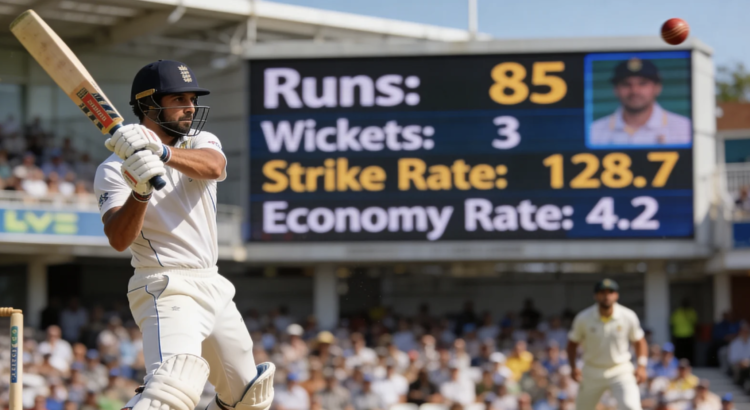
Batter runs Over/Under is the most widely available individual market. Good sportsbooks will price up a range of individual markets for each batsman for every innings. Typically, batter runs markets are listed as Over/Under. You bet on whether the batter’s total runs will be over or under the mark set by the bookmaker.
The line is set based on the player’s recent form, position in the batting order, venue average, and opposition bowling quality. A line of 34.5 for Rohit Sharma in a T20I means the bookmaker expects him to score around 35 — and the Over/Under odds reflect the probability distribution around that expectation.
Bowler wickets Over/Under follows the same structure. Common lines: 0.5 wickets (will the bowler take at least 1?), 1.5 wickets (at least 2?), 2.5 wickets (at least 3?). In T20 cricket, a line of 1.5 wickets for a quality fast bowler implies approximately 40–50% probability based on career averages — meaning the Over at typical odds of 1.90–2.10 is close to fair value.
Player performance points is a composite market offered by premium sportsbooks. The sportsbook awards points based on runs scored or wickets taken. Players can also earn points by making catches or stumping. For example, a bookmaker prices up Jason Holder as 1.85 on the Over/Under 32.5 points. He takes four wickets and one catch but does not bat. His total player performance ends up 45 points. The over 38.5-points bet therefore wins. This market rewards all-round contributions and is particularly valuable for genuine all-rounders.
Player head-to-head — race to X runs: Pick between two batters to see who will reach a given number of runs first (e.g., Race to 30). If neither reaches the target, the market may void.
Top Batter And Top Bowler Markets
Top batter (team) — predicting the highest run-scorer for a specific team in a match or innings. This is structurally different from the runs Over/Under market: you are not predicting an absolute score, but a relative one. A batter who scores 28 can win the top batter market if everyone else scores less.
Settlement nuance for top bowler: If two or more players take the same number of wickets, the bowler with the least number of runs conceded is deemed the winner. This tie-break rule matters for top bowler selections — when backing a bowler in a market with multiple quality options, their economy rate as well as wicket-taking ability determines the outcome in deadlock scenarios.
Dead heat rules for top batter: When two batters finish on identical scores, most bookmakers apply dead heat rules — winnings are divided proportionally by the number of players sharing the result. This reduces the effective payout in tied outcomes and should be factored into stake sizing for top batter bets where multiple candidates are close in form.
Strategies For Player Performance Betting
Five principles consistently improve accuracy in player performance markets:
Position-specific analysis before career averages: A batter’s position in the order determines their probability distribution more than their career average. An opener faces the new ball for the full innings — higher ceiling, higher early-wicket risk. A No. 7 batter may have a high career average but faces limited balls in most matches. Always calibrate the runs line against the player’s expected balls faced at their batting position, not just their overall average.
Bowling workload confirmation: Before betting any wicket prop, confirm whether the bowler is at full fitness and expected to bowl their full allocation. An injured fast bowler restricted to 5 overs instead of 10 cannot accumulate wickets at the same rate as a bowler bowling their full spell. Pre-match team news and the captain’s statement on bowling plans are the most valuable inputs for wicket market calibration.
Match situation reading for live markets: Live betting allows you to adapt your strategy as the game unfolds. For example, if a top-order batter is dismissed early, you might bet on a middle-order player to score the most runs. In-play betting also lets you capitalize on shifts in momentum, making it ideal for T20 and ODI matches where the action is fast-paced. The best live player performance bets come from identifying a mismatch — a quality batter facing a weak bowling spell, or a bowling change that introduces a spinner against a team’s weakest players against spin.
Format-specific benchmarks: Player performance distributions differ significantly across formats. In Tests, a batter averaging 40 might score 60+ in 30% of innings; in T20Is, a 50+ score occurs in only 15–20% of innings due to the shorter format. Betting the same runs line for the same player across formats without adjusting for format-specific distribution is a systematic error.
Opposition-specific matchup analysis: Bowlers like James Anderson are almost unbeatable on home soil and betting on him for a match being played in England is a wise decision. His results outside his home country are not so undisputed, however, and you better think twice before backing him with a bet in a match conducted in India for example. The same principle applies to batters — head-to-head records against specific bowling attacks, and performance at specific venues, are more predictive than global career averages.
Best Situations For Player Performance Bets
Three match scenarios consistently produce the highest accuracy in player performance betting:
Flat pitch conditions with quality openers: On flat batting surfaces at high-scoring venues — Wankhede (Mumbai), Chinnaswamy (Bengaluru), Eden Gardens (Kolkata) — the runs Over on quality top-order batters carries structural support. IPL 2025 confirmed the trend: these venues produced the highest first-innings averages of any grounds in the competition, with Hyderabad’s Rajiv Gandhi International Stadium averaging 65.5 runs in the powerplay phase alone.
ICC knockout matches for premium players: The frequency with which elite players produce match-defining performances increases in knockout cricket. Virat Kohli’s 8 Player of the Match awards at T20 World Cups, Rohit Sharma’s average of 60.93 in ODIs since 2023 (highest of any player with 1,000+ runs), and Jasprit Bumrah’s role as India’s primary wicket-taker in elimination matches — all of these confirm that top players perform at or above their career average frequencies in high-stakes tournament cricket.
Bowling change in live markets: Watching momentum shifts — such as a batsman struggling against spin or a bowler gaining reverse swing — can help identify value bets before the odds adjust. When a bowling change is made mid-innings and the new bowler matches up favourably against the current batter (a left-arm spinner against a right-hander with a documented weakness against left-arm spin), the wicket prop for that specific bowler carries temporarily elevated probability before the market fully adjusts.
Conclusion: Improving Accuracy In Player Betting
Player performance markets reward a specific type of analytical work that match-winner betting does not: individual-level research that combines career statistics with match-specific context. The bettor who knows that Suryakumar Yadav’s MOTM rate is 17 in 105 T20I appearances — a 16% frequency — can identify when his MOTM odds at 5.00 (20% implied probability) represent positive expected value. The bettor who knows Pat Cummins’ Test economy is 2.90 can identify when economy props above 3.00 carry Under value.
The market structure of player performance bets also rewards patience. It’s better to place fewer, well-researched wagers — whether it’s a match winner market or a targeted player props cricket bet — than to spread your bankroll across too many games. In a market with dozens of individual player lines per match, the discipline to bet only the lines where the analytical case is strongest — and pass on everything else — is the defining characteristic of consistent player performance bettors.
Confirm fitness and playing XI before placing, and apply venue-specific career data rather than global averages. The depth of cricket’s player performance market means the analytical edge available to a prepared bettor is broader here than in almost any other sport.